There’s a prevailing idea in the literary scene that comics and graphic novels have no place amongst capital “L” Literature. It’s not surprising– after all, these are the same people who turn up their noses at genre fiction and romance, even though many of the books they venerate fall into the aforementioned categories or founded the categories they’re so hellbent on gatekeeping. But something is different about comics. It’s not just the folks trying to dictate what counts as “true” literature who think graphic novels don’t belong on the same shelves as traditionally written work; a lot of the population feels this way. In the same way animated movies are automatically classified as “Children’s Media”, graphic novels are assigned to separate shelves in bookstores next to the Young Adult section.
What this leads to is a kind of hilarity. When one finds the graphic novel or comics section in a bookstore, they’ll find serialized Japanese manga next to Art Spiegelman’s Maus or The Watchmen next to the latest Marvel comic. You’ll be hard-pressed to find the same kind of quality, theme, and content whiplash anywhere else in a store dedicated to categorizing the written word. It’s like finding the movie Grave of the Fireflies shelved next to Disney’s Toy Story. Clearly, there is a large leap between content and intended audience, but due to their nature as graphic novels or animated movies, no one wants to think about how else to classify them. They’re comics, cartoons. They’re devalued.
Not everyone thinks this way. If they did, we wouldn’t have any comics to read. I’ve personally been a fan of graphic novels since reading Captain Underpants as a kid. My love of graphic novels, comics, and the innovative world of webcomics has only grown as I’ve aged. Which is why I realized that, in creating this blog, I’d messed up.
Even with my love of comics, I unconsciously threw them in the “non-literary” pile while compiling my book lists. There were no graphic novels on last year’s list, and none on this year’s list either– until I stumbled across reviews for On a Sunbeam. Determined not to gatekeep one of my own favorite methods of storytelling, I put it on the list. While the majority of this year’s Book of the Month list was recommended by you, my lovely readers, this is the one book I chose for myself.
Tillie Walden’s On a Sunbeam spans two timelines, several characters, and the far reaches of space. In a world falling apart, our main character Mia travels with a restoration team to rebuild the past while coming to grips with her own. It’s at once a coming-of-age story and a love story, though the kind of love it strives to represent doesn’t stop at the romantic. Written at a break-neck pace of one thirty-page chapter a week between the fall of 2016 and the spring of 2017, Walden creates a complex, charismatic world that she published online for free. To this day, On a Sunbeam can be read at no cost on her website, allowing anyone to follow Mia on her journey of self-discovery and reconciliation.
What initially drew me to On a Sunbeam was the art style. Walden’s lines are thin and uniform, yet she manages to represent an entire cast of characters and full, rich backgrounds without changing her strokes. The palette is equally barren, made primarily of blacks, blues, reds, and yellows. White is used sparingly, mostly appearing in speech bubbles and background details, lending the entire comic a very dense, heavy feeling that correlates with the vastness of space. When white is used for backgrounds, the entire section feels highlighted, drawing our eye and indicating importance and, in most cases, an emotional lightness in the content. Put all these elements together with Walden’s Studio Ghibli-inspired character design, where each character is simplistic yet recognizable and expressive, and On a Sunbeam reads as visually dynamic yet familiar.
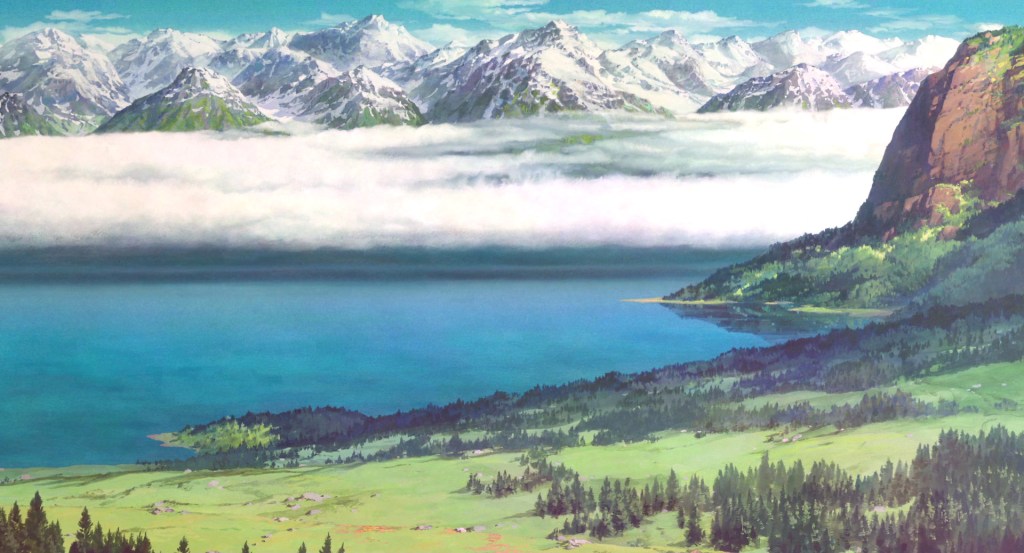
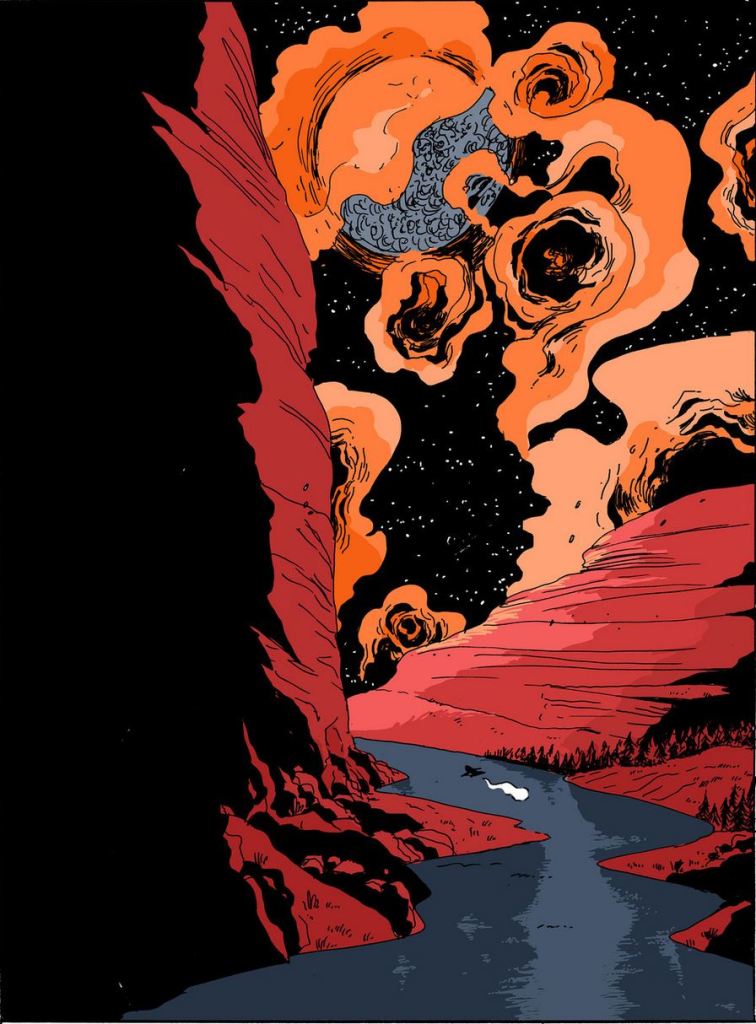
Style isn’t the only area in which Walden was clearly inspired by the works of Hayao Miyazaki. While the book takes place in the far future, with advanced tech and accessible space travel, On a Sunbeam is anything but traditional sci-fi. The novel focuses on the relationships between characters and their emotional responses to events, not the overarching world or its systems. There are full pages dedicated to scenery or quiet moments where no character is talking, simply to evoke a mood and an introspective feeling as time passes. Walden’s novel is much closer to being described as a coming-of-age story that happens to be set against a sci-fi backdrop. It’s refreshing to read a book where the sci-fi is so “soft”, or unexplained, to focus instead on the character moments and interpersonal relationships.
That’s not to say Walden doesn’t build out her sci-fi world. On the contrary, there’s plenty of interesting world-building happening in the background. Little details like the school-game Lux, the beta fish starcraft, ancient space temples floating and falling into disrepair, and the hybridized Dungeons & Dragons tabletop videogame the characters play in their downtime all add up to an interesting world that feels inhabited and lived in. Who that world is inhabited by is just as important– throughout the novel, there is not a single male character outside of the ship’s cat, Paul. This small environmental detail reinforces the queer reading of the book, from the romantic relationships to the found family narrative that takes place amongst the diverse crew of the Aktis.
In the entire 500+ page book, there were a few moments that jarred me enough to take me out of the world. Cliche elements like Mia’s haircut scene and the training for combat sequence felt unneeded, especially in a book that so thoroughly waves away other traditional sci-fi conventions. And, after so much of the world-building had been on the periphery, the exposition dump on The Staircase slowed me down considerably. Still, these issues are counterweighted by my awe of the pace at which Walden released the comic online. To create something so coherent and beautiful in such a short time is nothing short of amazing. To have a few gripes is expected. Nothing created at that speed could possibly be perfect.
Overall, On a Sunbeam turned out to be exactly what I thought it would be. The entire narrative is like being wrapped in a warm hug or turning on your favorite Studio Ghibli film with a mug of tea in your hands. Even if you’re hesitant about reading a graphic novel (or a webcomic), I highly recommend you give Walden’s work a shot. It’s a relatively quick read that will leave you with a higher appreciation of the format and queer sci-fi. I hope you’ll all join me as we continue our dip into queer literature with next month’s book, the foundational Stone Butch Blues by Leslie Feinberg. Until then, happy reading and happy sipping!
 Tea Reads